@TheJayster99: Garry Kasparov is a chess grandmaster from Russia, and at the time, the world champion. Deep Blue was a supercomputer designed and built by IBM, specifically for the purpose of playing chess against a human opponent; its predecessor, Deep Thought, had lost to Kasparov in 1988 and 1989. Kasparov and Deep Blue played two matches against each other, each consisting of six games. The first match, played in Philadelphia in February of 1996, ended with a victory for Kasparov. However, the second match, held in New York City in May the following year, ended with Deep Blue defeating Kasparov. I remember it being a pretty big deal at the time– a clear demonstration that machine learning was advancing to the point that it could ‘outthink’ a human. It was widely thought then that this could have major positive implications for all sorts of industries. How naive we were back then. Thirty years later, of course, we’ve got a much less rosy outlook on that sort of technology.
Okay, people, chess is one of the games computers can be really, really good at, because, Capt. Kirk notwithstanding, it’s a game of pure logic. There is no random chance, abstract thought barely factors in, and a computer with enough power and time can make the optimal move, every move.
At the time of this comic, Garry Kasparov, then world chess champion, has beaten Deep Blue, a computer made by IBM, in a six-game series, partially due to Kasparov starting to learn Deep Blue’s tactics, and partially to the IBM team refusing a draw basically to see what would happen.
In May 1997, Deep Blue will win a rematch, and then we really don’t care for a while.
@wingweaver84 I personally think it would be difficult for an AI to beat a human at chess. The reason I think is that AI doesn’t have the capability of abstract, sentient thought. But if there is a human who was beat by AI in chess, its because said human isn’t as cognizant as the person who wrote it in the first place. But I could be wrong and talking out of my ass, so who knows.
@Jayster I think it’s in reference to the guy who built a computer program to win chess or something like that-to prove that a computer would be better at chess than a human. Correct me if I’m wrong.
I… cannot say I know what “Deep Blue vs Garry Kasparov” is, but it sounds like this might be a dig at AI loooooong before it became the problem it is today so this certainly should be interesting.
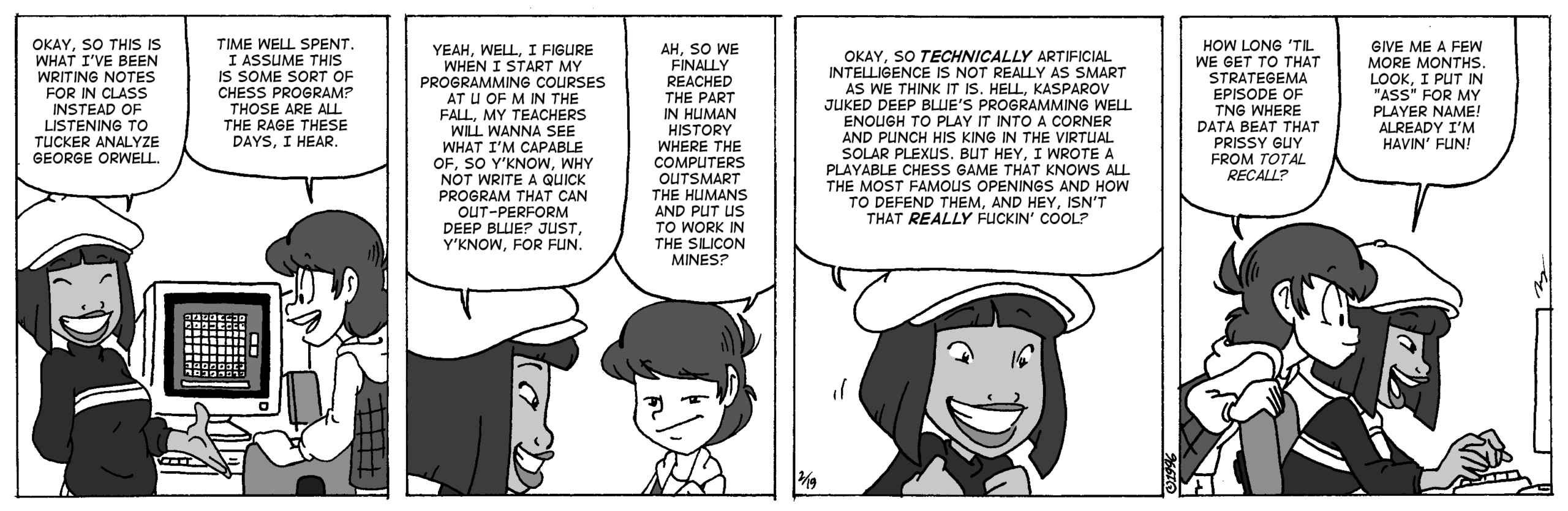
I always love seeing Michelle geek out about tech stuff.
You know Michelle, considering what’s going on now learning about George Orwell’s works would have been a good thing.
Michelle’s cute when she geeks out like this.
Also, want to impress the professors, Michelle? Write a program that plays Go.
@TheJayster99: Garry Kasparov is a chess grandmaster from Russia, and at the time, the world champion. Deep Blue was a supercomputer designed and built by IBM, specifically for the purpose of playing chess against a human opponent; its predecessor, Deep Thought, had lost to Kasparov in 1988 and 1989. Kasparov and Deep Blue played two matches against each other, each consisting of six games. The first match, played in Philadelphia in February of 1996, ended with a victory for Kasparov. However, the second match, held in New York City in May the following year, ended with Deep Blue defeating Kasparov. I remember it being a pretty big deal at the time– a clear demonstration that machine learning was advancing to the point that it could ‘outthink’ a human. It was widely thought then that this could have major positive implications for all sorts of industries. How naive we were back then. Thirty years later, of course, we’ve got a much less rosy outlook on that sort of technology.
Okay, people, chess is one of the games computers can be really, really good at, because, Capt. Kirk notwithstanding, it’s a game of pure logic. There is no random chance, abstract thought barely factors in, and a computer with enough power and time can make the optimal move, every move.
At the time of this comic, Garry Kasparov, then world chess champion, has beaten Deep Blue, a computer made by IBM, in a six-game series, partially due to Kasparov starting to learn Deep Blue’s tactics, and partially to the IBM team refusing a draw basically to see what would happen.
In May 1997, Deep Blue will win a rematch, and then we really don’t care for a while.
*sigh* Those silicon mines didn’t feel so inevitable back then…
@wingweaver84 I personally think it would be difficult for an AI to beat a human at chess. The reason I think is that AI doesn’t have the capability of abstract, sentient thought. But if there is a human who was beat by AI in chess, its because said human isn’t as cognizant as the person who wrote it in the first place. But I could be wrong and talking out of my ass, so who knows.
Oh, god…
@Jayster I think it’s in reference to the guy who built a computer program to win chess or something like that-to prove that a computer would be better at chess than a human. Correct me if I’m wrong.
Deep Blue, the early precursor to AI 30 years later. This will be fun.
I… cannot say I know what “Deep Blue vs Garry Kasparov” is, but it sounds like this might be a dig at AI loooooong before it became the problem it is today so this certainly should be interesting.